
In solar module manufacturing, incoming glass must pass through several preparation steps before entering production, including material identification, pallet alignment, pallet separation, removal of strapping and protective wooden boards, waste recovery, and glass transfer.
SC Solar integrates these operations into a fully automated glass unpacking line. AGVs, conveyors, vision systems, and robots work together to automate the entire process, from loading and pallet separation to unpacking, material recovery, and unloading. This integrated approach reduces waiting time and repeated handling while ensuring a stable and efficient supply of glass to the module production line.
Seamless Material Flow and Automated Unpacking
AGVs connect the unpacking line with upstream and downstream logistics. After each glass pallet is loaded, the system automatically aligns the pallet and scans its product label. The stacked pallets are then separated before robots remove the strapping and protective wooden boards.
Once unpacking is complete, a rail-guided transfer cart and lifting mechanism move the glass to the unloading position, where it is collected by an AGV. Removed strapping and wooden boards are transferred to the corresponding recovery systems.
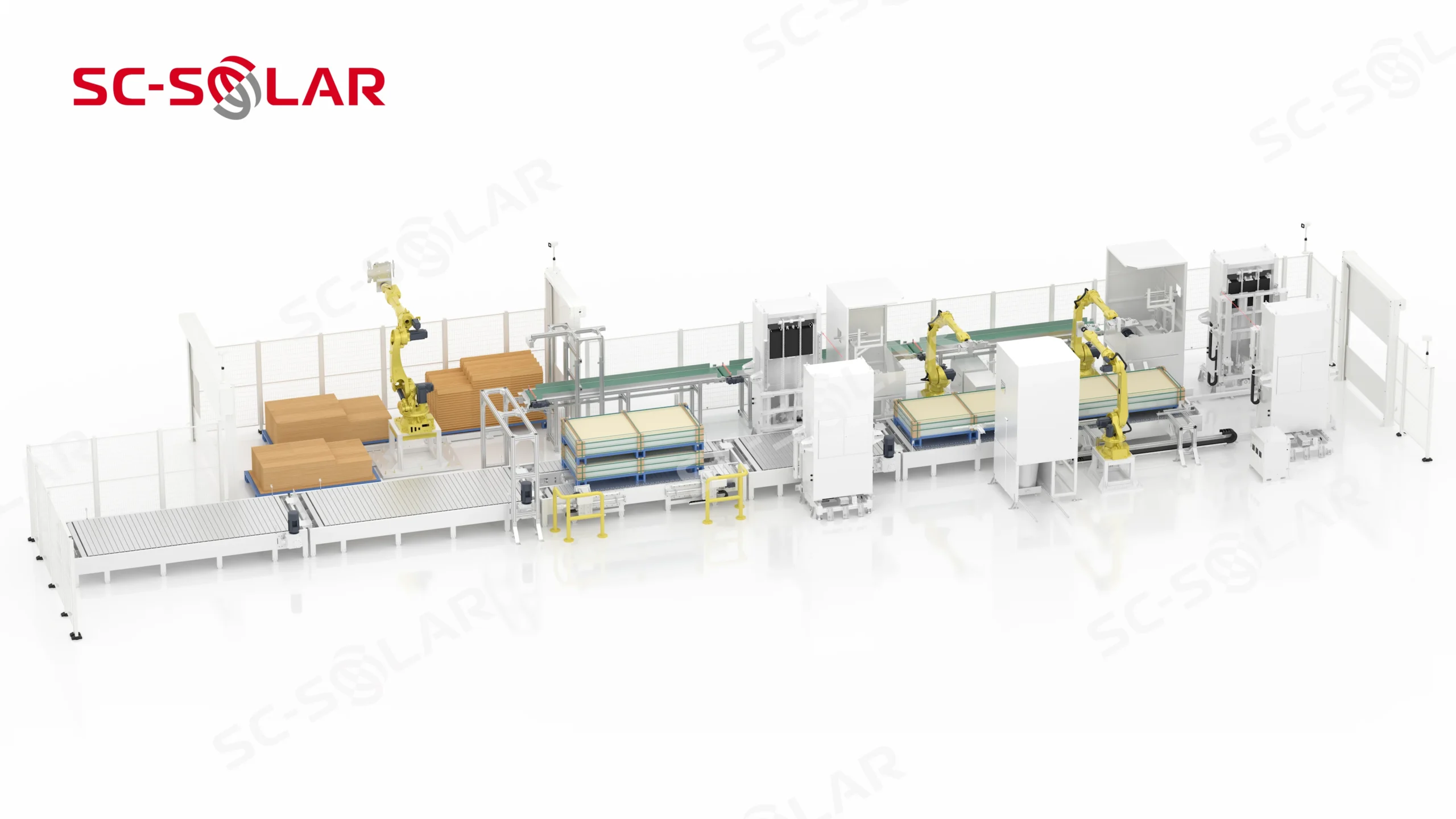
By integrating AGVs, vision systems, six-axis robots, and conveying equipment, the line turns multiple standalone operations into one continuous process. Product label data supports automatic product matching and recipe changeover, while vision-guided robotic handling improves accuracy and operational stability. Coordinated material flow reduces manual intervention and keeps production takt time stable and controllable.
Flexible Compatibility and Stable Output
The line accommodates glass ranging from 1,640 to 2,520 mm in length and 992 to 1,450 mm in width. It supports pallet thicknesses from 150 to 200 mm and can be customized for specific production requirements.
Based on product label data, the system automatically selects the corresponding program and switches between different module formats, enabling mixed-model production.
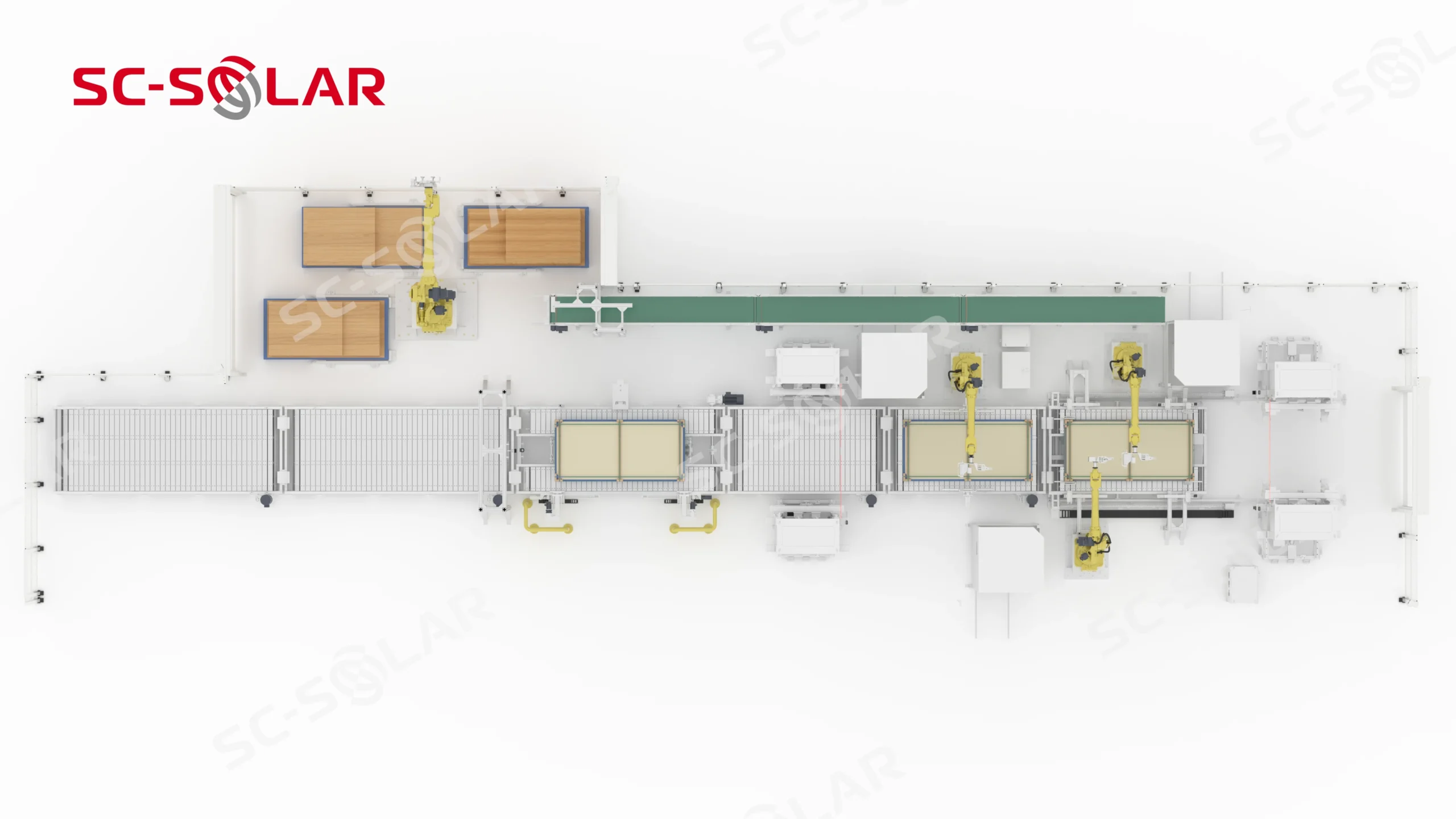
The line achieves a cycle time of no more than 120 seconds per pallet. Based on 11.5 effective production hours per shift, one line can process approximately 345 pallets per shift. Depending on the actual product and factory configuration, it can support up to 12 single-glass module lines or six dual-glass module lines.
The layout can also be adapted to available floor space, AGV routes, loading and unloading directions, and downstream production interfaces, ensuring smooth integration with different factory and logistics configurations.
Automated Recovery for Leaner Operations
In addition to glass handling, the line automates the recovery of strapping and protective wooden boards. Removed strapping is sent to a centralized shredding unit, while long, short, and L-shaped wooden boards are sorted, conveyed, and stacked automatically. Once a preset quantity is reached, an AGV transfers the recovered materials to the designated area.
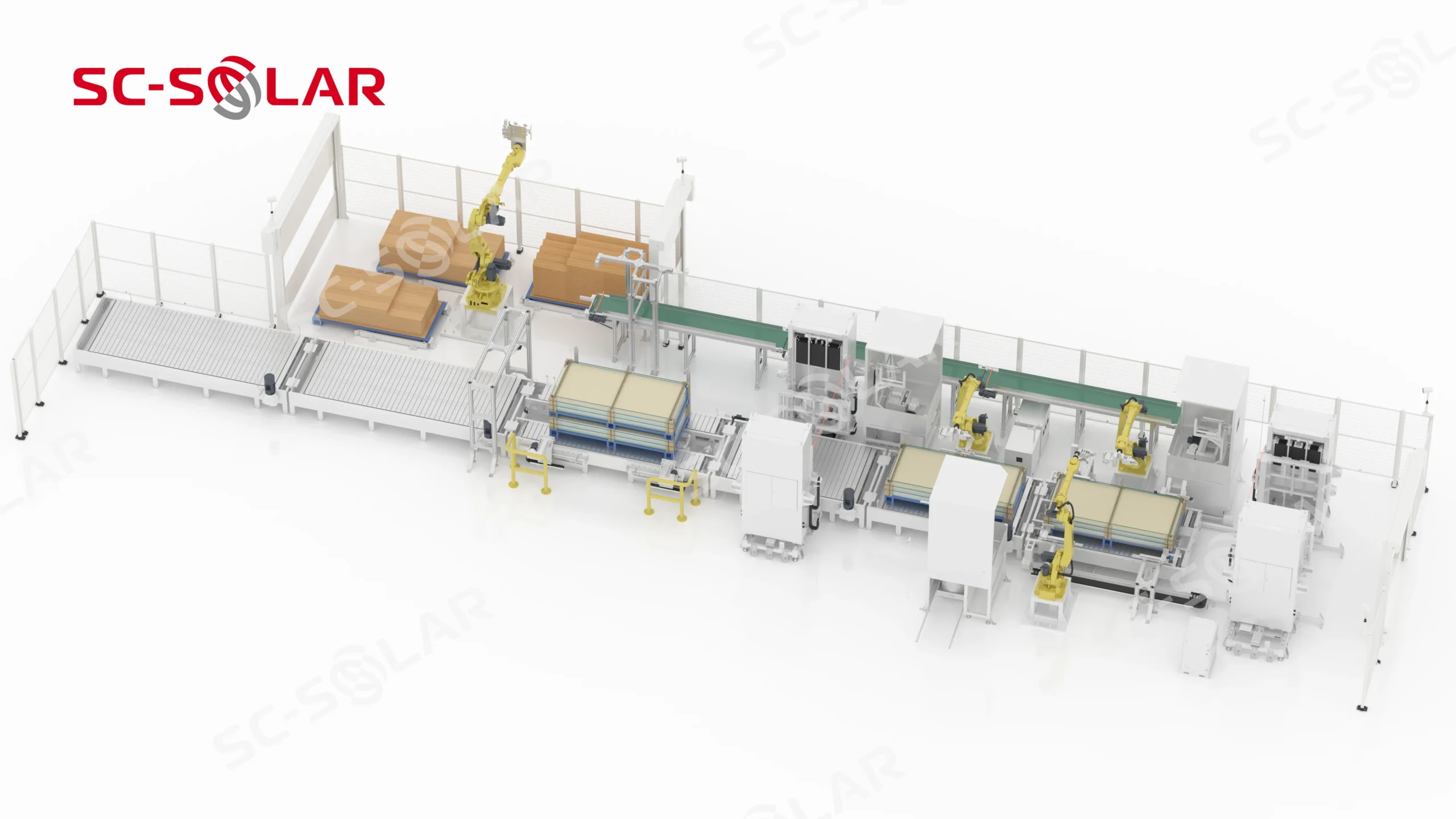
Integrating unpacking, recovery, and transfer reduces manual handoffs, process waiting, and material accumulation on the production floor. It improves operating continuity, floor-space utilization, and workplace management while reducing labor requirements and supporting lean module production.
Looking ahead, SC Solar will continue advancing factory-wide automation by connecting glass unpacking, module production, finished-product packaging, high-bay warehousing, and automated truck loading. By delivering efficient, stable, and traceable manufacturing systems, SC Solar is helping customers build truly automated module factories and making solar manufacturing easier.